what happened to defense spending during the cold war
Ronald Reagan`s Armed services Buildup
After America airtight her doors to an expensive state of war in Vietnam (1975)1, the nation was in need of an overhaul of the economy, military, and public morale. Ronald Reagan'south 1980 presidential victory signaled what many believed the country needed to get back on its superpower feet over again. Earlier Reagan's ballot The belatedly 1970s had witnessed the triumph of Marxist governments in Angola and Nicaragua. El salvador seemed ready to follow adapt. The U.Southward. had been humiliated by the consequence of the Vietnam War (1975), and the Soviets seemed secure in their unrelenting mission to conquer Afghanistan. Islamic fundamentalists had come to ability in Iran. They had captured 52 embassy Americans as hostages, and the Jimmy Carter administration had made a bitterly unsuccessful endeavor to rescue them. As a result of Carter Administration policies, the American military was plagued by depression morale, low pay, outdated equipment, and practically nothing maintenance on what did exist. Important U.S. armed forces personnel were non reenlisting; it just wasn't worth it to them. In fact, thousands of enlisted men's families survived on food stamps. The U.S. economy was struggling, burdened by seemingly unstoppable aggrandizement. High tax increases and an upward spiral of interest rates were an everyday occurrence for Americans. The United states of america seemed in an era of limits; the state seemed to be running out of oil, and in practice, U.S. foreign policy had adopted a stance of co-being with the Soviet Wedlock and Prc. In 1980, the American electorate shooed in a leader with an heart toward countering domestic social changes wrought past Ceremonious Rights and Affirmative Activity programs and military machine superiority and a new sense of political direction. Ronald Reagan was inaugurated the 40th president of the Usa in 1981. 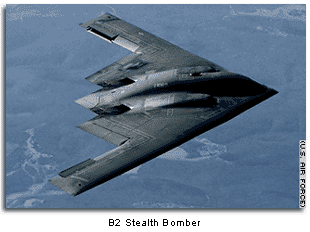 Victory through strength Defence force secretarial assistant Caspar Weinberger was the new president's right-hand man throughout his mission to build up a massive military to vesture down the Soviets in what would be the final years of the Cold War. Reagan's administration revived the B-i bomber programme, which had been canceled by the Carter Administration, and began production of the MX Peacekeeper missile. Reagan's response to Soviet deployment of the SS-20 missile was his approval of NATO's deployment of the Pershing II missile in West Germany, despite much protestation. By the time Reagan stepped down from the captain, he had expanded the U.South. military machine budget to a staggering 43% increase over the full expenditure during the height of the Vietnam state of war. That meant the increase of tens of thousands of troops, more weapons and equipment, non to mention a beefed-up intelligence program. "Star Wars" One of Reagan's controversial proposals was the Strategic Defence force Initiative (SDI), a arrangement intended to brand the U.S. invulnerable to nuclear missile attacks by the Soviet Union. Past stationing those defenses in outer infinite, the U.S. was able to circumvent the United Nation'south Anti-Ballistic (ABM) Treaty. In a speech in 1983, President Reagan announced his plans to create a shield confronting nuclear missile attacks. The news media quickly dubbed his new proposal for the SDI equally "Star Wars," as well equally characterizing it equally a carelessly fatigued-up science fiction idea. Based upon original work by Nikola Tesla, SDI was designed to vaporize missiles from space by way of a laser guidance system, before they reached U.Southward. soil. The arrangement grew into a series of systems that also formed a layered ballistic missile defense. The SDI was capable of zeroing in on simply thirty percent of the earth'southward surface, and wasn't able to get a set up on the Soviet'southward nuclear launch sites. By 1985, after billions of dollars just minimal results, Reagan'southward SDI was shut downwards but research continued. The fence over such a defense programme continues to simmer over its advisability. Merely the elusive technologies of that fourth dimension are a reality now, in the early 21st Century. This is not to state that the 1980's SDI is now a reality, just the portable loftier powered laser beam which has been deployed in large aeroplanes and in Infinite.
Lasers accept been studied for their usefulness in air defense since 1973, when the Mid-Infrared Advanced Chemical Laser (MIRACL) was first tested against tactical missiles and drone aircraft. Work on such systems continued through the 1980s, with the Airborne Laser Laboratory, which completed the offset test light amplification by stimulated emission of radiation intercepts to a higher place the world. Initial piece of work on light amplification by stimulated emission of radiation based defence force systems was overseen by the Defence force Advanced Research Projects Agency2 (DARPA), but transferred to the newly created Strategic Defence Initiative Organization (SDIO) in 1984. Work continues today under the auspices of the BMDO, the successor to the SDIO. Current SBL planning is based on a 20 satellite constellation. Impale times per missile volition range from 1 to ten seconds, depending on the range from the missile. Retargeting times are calculated at as low equally 0.5 seconds for new targets requiring small bending changes. Thus a system consisting of twenty satellites is expected to provide nearly full threat negation. Progress and criticism Throughout President Reagan's two terms (1981-1989), military spending was very high; still, he was able to accomplish it without breaking out into an economical sweat. Reagan's assistants managed it while enjoying noticeably positive growth — albeit with massive budget deficits. The Reagan years also saw the ancestry of a dramatic era of innovation. "Silicon Valley"3 came into its ain. By dissimilarity, the Soviet Matrimony, and its military, was in an economic dilemma while attempting to stay in the race for preeminence, and their computing industry lagged far behind the W. Over the years, many analysts have scrutinized Reagan'south credibility equally a military planner. Some critics have maintained that he engineered the greatest war machine forcefulness of all times, but did and then with much waste — tripling the national debt. Such projects equally taking World State of war II battleships out of mothballs and modernizing them were of questionable military value to some. Furthermore, reviewers have noted that the president cruel brusk on some objectives, such every bit his goal of building a 600-ship navy and his Star Wars plan. Despite those debates, the Pentagon acknowledged its debt to the 40th president of the United States: Its newest, most modernistic aircraft carrier is operational — tellingly dubbed the USS Ronald Reagan. The Reagan administration managed to keep America out of a major war for virtually a decade — merely with several scary nuclear shut calls. Much of the nation's electric current firepower is a legacy of the Reagan years. The Soviet Spousal relationship began to crumble in 1989 with the toppling of the Berlin Wall. America had emerged triumphant and the Cold War was officially ended in 1990. 1: The Fall of Saigon, (known also as the Liberation of Saigon) on Apr thirty, 1975. 2: Defence Advanced Research Projects Agency, (DARPA), is the agency that created the original Internet 3: "Silicon Valley" is the euphamistic proper noun given to the expanse between San Jose and Palo Alto California. Palo Alto is a suburban city where Stanford Academy is located. Nearby is Moffet Field, a Navy base situated on San Francisco Bay contains the primary Internet hub on the West Declension and San Jose whose fields of tulips, corn and orange groves succumbed to a building nail for technology companies.
Source: https://www.u-s-history.com/pages/h1957.html
0 Response to "what happened to defense spending during the cold war"
Postar um comentário